BURNIER LAB
Canadian Conference on Circulating Biomarkers
The RI-MUHC Circulating Biomarkers of Health and Disease Research Network was established to advance research on circulating biomarkers across health and disease. The network brings together researchers, clinicians, trainees, and patient partners at the Research Institute of the McGill University Health Centre (RI-MUHC) and beyond. It promotes interdisciplinary collaboration, knowledge exchange, and translation through scientific meetings, workshops, and collaborative research initiatives. The 2026 Canadian Conference on Circulating Biomarkers (CCCB) represents the network’s inaugural national conference, marking a key milestone in building a coordinated Canadian community focused on circulating biomarker research and clinical implementation.
PILLARS OF RESEARCH
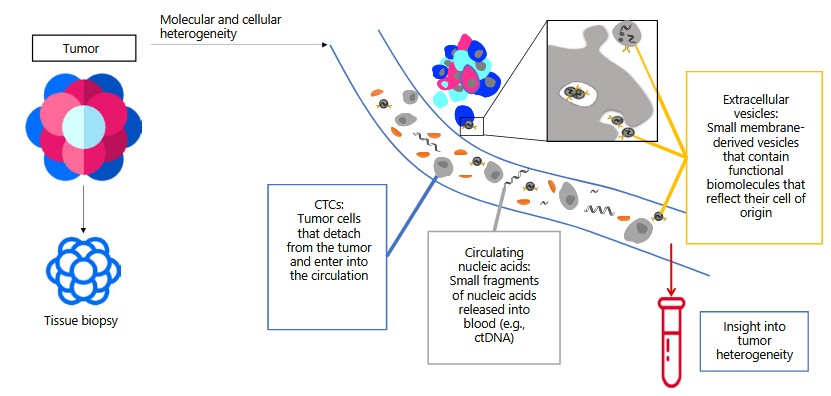
Circulating tumor (ct) DNA liquid biopsy for cancer detection and treatment monitoring
This pillar focuses on understanding the dynamic molecular changes that occur during tumour progression and metastasis through liquid biopsy. Our ability to study tumour biology and uncover new approaches to prevent and treat cancer is limited because it relies on tissue from a biopsy, which carries several issues: inadequate sampling, rare but serious complications, and, importantly, the limitation of having one static picture of the tumour – thereby neglecting the dynamics of tumour evolution. To overcome these issues, our lab tracks tumour evolution through a liquid biopsy, a minimally invasive approach to monitor disease progression, recurrence and treatment response using a blood sample. Detection of circulating tumour cells, DNA, and extracellular vesicles (EVs) can contribute to early diagnosis and personalized management. Liquid biopsy can inform on the changing mutational status of the disease and help to guide therapy. Our lab works towards identifying specific initiating and metastasis-promoting mutations that can track disease through ctDNA as a biomarker.
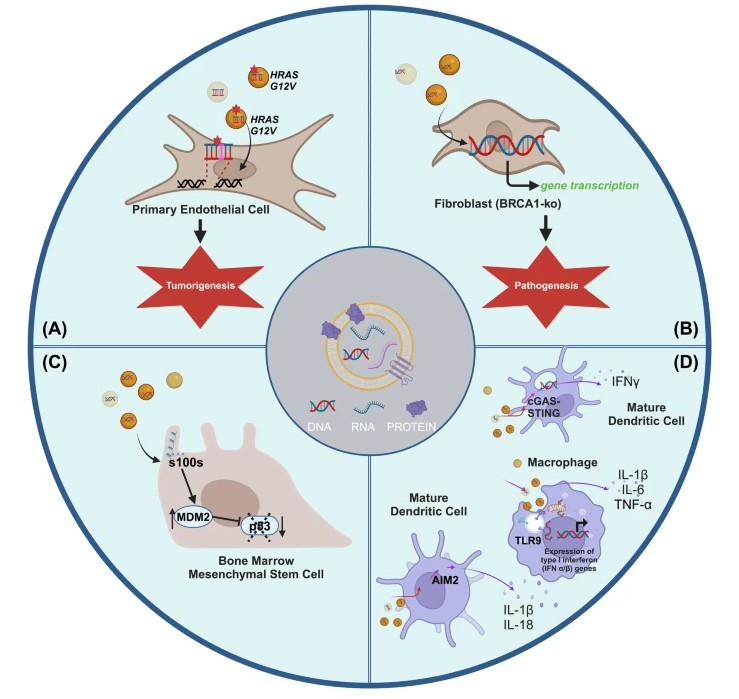
Extracellular vesicle-associated DNA (EV-DNA) biology and function
This pillar focuses on unveiling the basic biology and functional of EV-associated DNA (EV-DNA) in cancer. EVs have emerged as key players in intercellular communication, facilitating the transfer of crucial cargo between cells. Liquid biopsy, particularly through the isolation of EVs, has unveiled a rich source of potential biomarkers for health and disease, encompassing proteins and nucleic acids. A milestone in this exploration occurred a decade ago with the identification of EV-DNA in the bloodstream of a patient diagnosed with pancreatic cancer. Subsequent years have witnessed substantial advancements, deepening our insights into the molecular intricacies of EV-DNA emission, detection, and analysis. Our lab is interested in EV-DNA as a liquid biopsy biomarker for cancer patients and the mechanisms and biological significance of DNA packaging into EVs.
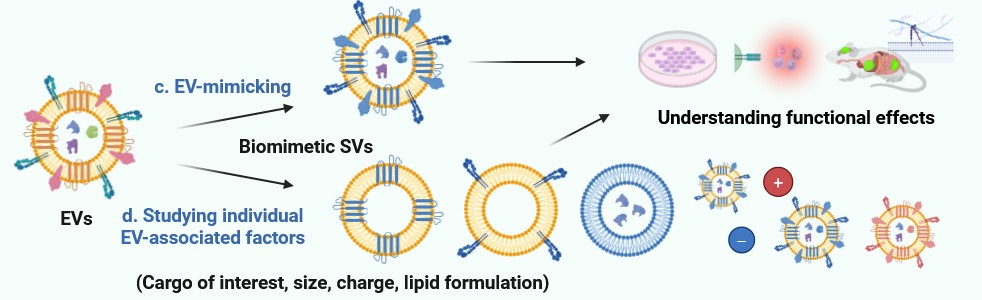
Synthetic EV-mimetic particles as a tool for discovery and rational therapeutic delivery
EVs have been shown to play an important role in cancer and metastasis by delivering their cargo to recipient cells in the microenivironment. While EVs transfer thousands of proteomic and lipidomic cargo to recipient cells, we hypothesize that only a fraction of the payload induces oncogenic transformation. To identify this fraction by studying natural EVs is difficult because they are heterogeneous in both size and composition. Moreover, knocking down individual proteins to study their potential role in malignancy is too time-consuming and cumbersome. To overcome these challenges, our lab seeks to develop biomimetic synthetic vesicles (SVs) via liposomes and lipid nanoparticles. These biomimetic SVs will help us uncover the role of individual EV-associated factors, model EVs and their behaviour using a bottom-up synthesis approach, and develop a drug delivery system for anti-cancer therapy.
Menu
Contact
Interested in joining? Send an email to julia.burnier@mcgill.ca
RI-MUHC Glen site
1001 Boul. Décarie. E01.2123
Montreal QC H4A 3J1
Designed with WordPress
 Julia Burnier Lab